Situated halfway between Larnaca and Limassol, the site of Kalavasos-Ayios Dhimitrioswas once a prominent urban centre during the Late Cypriot IIC (c. 1340–1200 BCE) period [1]. In modernity, the site is divided by the A1 motorway corridor which connects Nicosia and Limassol, resulting in three zones which were extensively excavated as part of the Vasilikos Valley Project: the Southeast Area, which contains domestic rubble architecture; the Central and East Areas; and the Northeast Area, where monumental mudbrick architecture and ashlar masonry supports theories that this area contained the centralisation of elite power at this settlement [2]. The Kalavosos and Maroni Built Environment (KAMBE) Project builds on this previous fieldwork –– specifically excavations led by Dr. Allison South from 1979–1998 –– and seeks to investigate the relationship between emerging urbanism and social changes of Late Bronze Age Cyprus [3]. As a member of KAMBE’s University of British Columbia team, I had the opportunity to excavate at Kalavasos-Ayios Dhimitrios from June 2025 – July 2025, under the direction of Dr. Kevin Fisher.
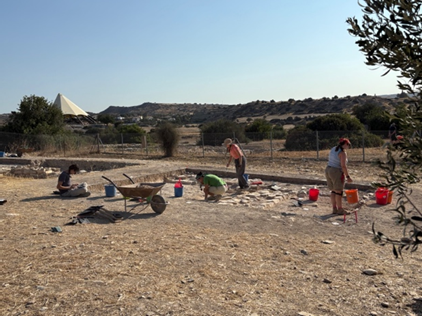
Previous seasons excavating in the Northeast Area, specifically Building XVI Unit 7, yielded evidence for ritual and feasting activities: this included deer skulls, Triton shells, wall brackets, and a circular stone feature. During the four weeks of the 2025 excavation, I worked predominately in a new trench, Unit 7 South Court. Surveying with ground-penetrating radar (GPR) of this area indicated the presence of possible architectural features, particularly thick exterior walls; resultantly, we laid out the parameters with intention to capture these features. By our final day on site, the trench measured 5 m by 8.5 m.
In South Court, we pickaxed and trowelled through three sediments –– topsoil, transitional mudbrick, and mudbrick –– before reaching the plaster floor. Actually digging through these layers gave me a richer understanding of the texture, colour, and compaction of this stratigraphy in a way merely reading about them doesn’t offer. This became particularly evident as we reached the floor level, and sometimes had to rely on sonic cues (the sound emitted when scraping a trowel across a surface) to differentiate between the compact grey-ish mudbrick and the white-grey plaster. Furthermore, as suggested by the GPR, our excavation revealed notable exterior walls, one of which ran East to West and another along the Eastern baulk, from North to South; both were roughly 1 m thick. The North–South wall aligned with sections of the exterior wall which were excavated in Rooms 1 and 3 –– trenches north of South Court. Other discoveries included ceramic sherds, slag, charcoal, unidentified pieces of bone, and a nearly 2 m long gypsum bench in the Northeast corner of the trench, positioned in front of the Eastern wall.
My participation in KAMBE was my first archaeological field experience, and from the first to final day on site I received a well-rounded education in the necessary procedures involved in excavation. This ranged from answering my questions surrounding how to start (the answer: with large pickaxes and shovels) to training in on-site data recording, such as photogrammetry, filling context sheets, and labelling bags for finds. These more administrative tasks were woven into the day-to-day aspects of digging on site and were integral to maintaining organised and accurate data collection as well as an overall smoother chain of operations.
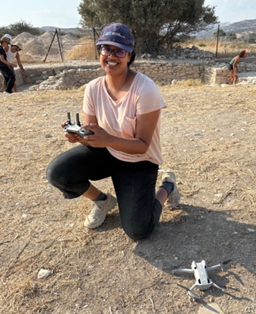
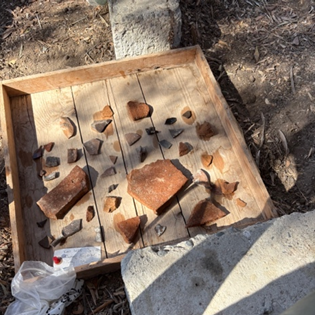
Not only did I train extensively in the methodologies of excavation, but I also gained experience in post-excavation processing techniques. As both trenches accumulated ceramic finds, we engaged in pottery washing off-site. Through this, we were able to identify the fabric of the sherds, which included White Slip, cooking ware, and even Mycenaean pottery. Additionally, we learned how to use flotation for soil samples. As digging drew to a close, we also learned how to hand sketch trench profiles and use drones to capture aerial images (pictured above). Moreover, our education didn’t stop as we wrapped-up digging, nor did it end with the workday: as part of the KAMBE experience, we were fortunate to engage in weekly trips to numerous archaeological sites around the island, from Paphos to Larnaca, and from the Troodos Mountains to Nicosia. We also immersed ourselves in Cypriot culture and customs throughout our stay in Kalavasos village, where the local people kindly hosted and fed us for the month.
I am thankful to the KAMBE Project for a thorough and versatile education in the practices of archaeological field work, as well as the ancient and modern culture of Cyprus, and I am grateful to CASOR’s financial contribution for supporting my first field experience. I am certain this opportunity will be an invaluable supplement to my knowledge as I progress in my academic career.
References
[1] Fisher et al. 2019: 477; South 1997: 151.
[2] Fisher et al. 2019: 478–79; South 1997: 151.
[3] Fisher et al. 2019: 473–477.
Bibliography
Fisher, Kevin D., Sturt W. Manning, and Thomas M. Urban. “New Approaches to Late Bronze Age Urban Landscapes on Cyprus: Investigations at Kalavasos-Ayios Dhimitrios, 2012–2016.” American Journal of Archaeology 123, no. 3 (2019): 473–507. https://doi.org/10.3764/aja.123.3.0473.
South, Alison K. (1997). “Kalavasos-Ayios Dhimitrios 1992–1996.” Report of the Department of Antiquities, Cyprus: 151–75.